For my stay in Rome, I have been on the Via Labicana, directly across the street from the church of SS. Marcellini e Pietro and there is a story that I think about every morning when I leave to go to the library.
In the year 827, Einhard, most famous as the biographer of Charlemagne, sent agents to Rome to retrieve relics for his new church in Seligenstadt. These agents meet a fellow while on the road who claims that he can help them, but he continuously demurs once they all arrive in Rome. After weeks pass, the agents grow impatient and decide to obtain relics for themselves. Late at night, they sneak into the crypts and first wanted to take the body of S. Tibertius, but his tomb was too difficult to open. Deciding instead to take the relics of the fourth-century martyr Marcellinus, the agents enter the church at night and remove the bones. Deciding that they could not separate Marcellinus from his burial companion, named Petrus, the agents break into the crypt a second time to take the second body. The agents then sent the bodies back to Germany with a different agent. If all of this sounds like stealing, you are absolutely correct and the agents admitted as such, but decided that these martyrs would be more venerated in Germany than in Rome. The agents reasoned that in Germany they would be unique, while in Rome they were simply two more martyrs out of hundreds. You can read this story in English or in Latin.
All of this took place in one of the catacombs and not the church itself, but because I see the church in which their relics are now buried, I think about it all the same.
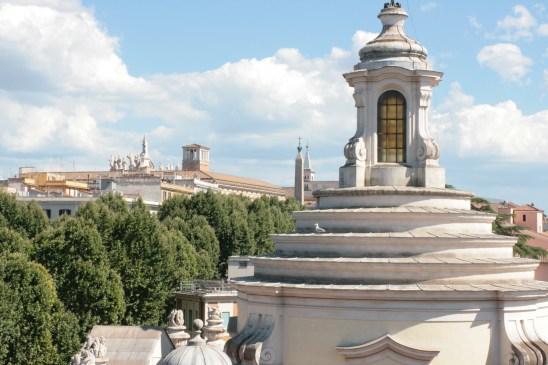
In the foreground is the dome of SS Marcellini e Pietro and the large roof with the collection of statues is the Lateran.
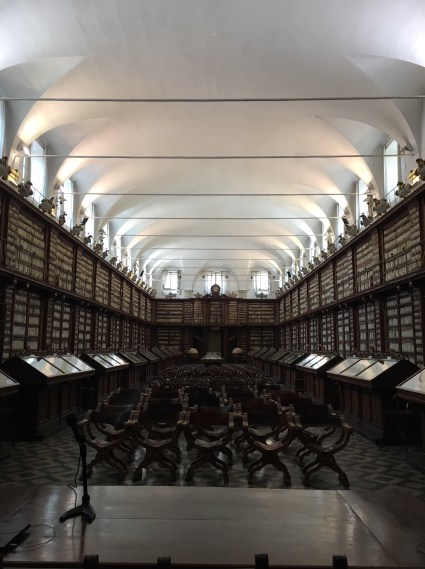
The original reading room at the Biblioteca Casanatense
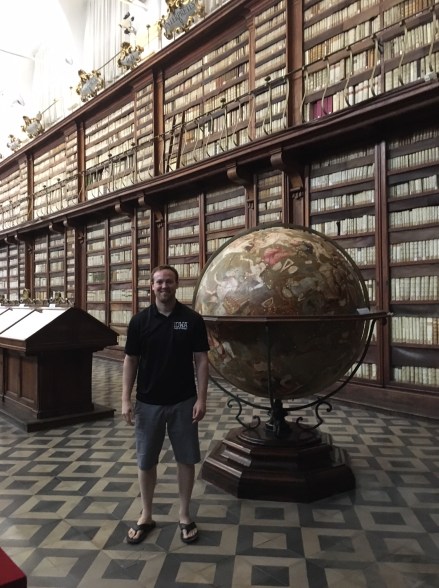
As an aside, if anyone has time while in Rome see the original reading room in the Biblioteca Casanatense, they should do so. Not many Roman libraries are open to tourists, so they should take advantage of the ones that are. I was particularly interested by four massive globes that show either the Earth or the locations of stars. The level of detail they contain and the care that went into their production is astounding. Just a thought for any other bibliophiles out there.
These old globes are amazing- I could have looked at them for hours.
Welcome to the blog documenting my research trip in the summer of 2018. I have spent the last four weeks in Rome examining various manuscripts for my dissertation.
The first week was spent in the Biblioteca Apostolica Vaticana, known more colloquially as the Vatican Library. This was my second stint there and I had forgotten both how imposing of a structure it is and how tight the security is: there are three checkpoints with armed guards (including one with actual members of the Swiss guard!) between the time you step off the Via Porta Angelica and when you reach the front door of the library. Once inside, you need a key card to check into almost literally everywhere- it seems as though only the bathrooms do not require you to scan your card.
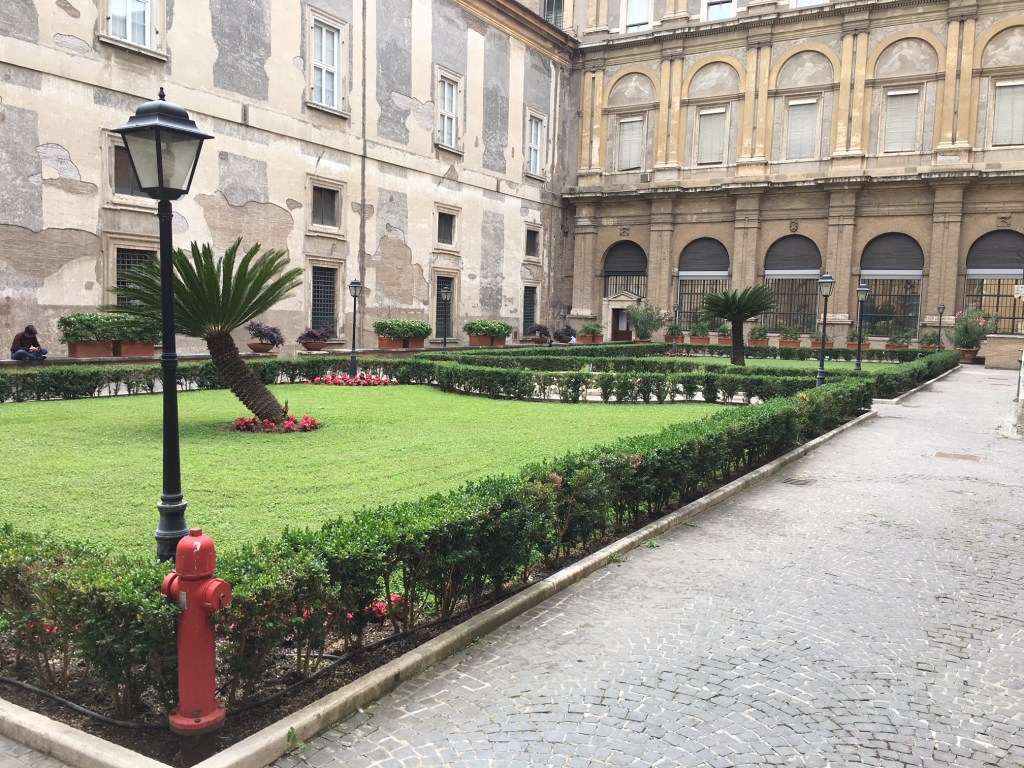
The cortile of the Biblioteca Apostolica Vaticana
Due to ongoing digitization efforts, a week there sufficed, as many of the manuscripts in the BAV registry of use to my project have been digitized. I did discover a nice little puzzle in one of the manuscripts (BAV Vat.Lat.316) that still has me stumped almost a month later- it is a faded fragment of something appended to a work of Agobard of Lyons that discusses both Isidore of Seville and Pope Telesphorus, who was a second century martyr-pope. Even a little bit of context would be helpful, but alas it is just the fragment. I shall report more when I figure it out. Not having access to the physical copies is a blessing in disguise, however, because it means that I can return to the digital manuscripts at a later date and instead move to libraries that do not have digital copies of manuscripts.
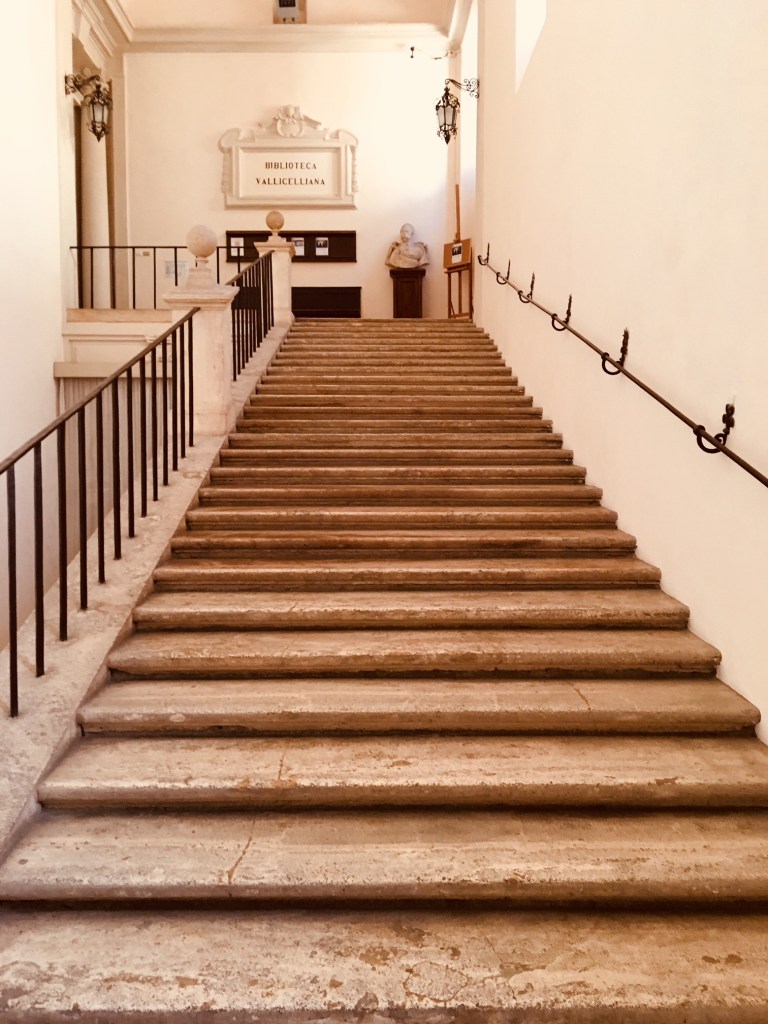
I was greeted by the famous Italian historiographer Lodovico Muratori everyday entering the Biblioteca Vallicelliana
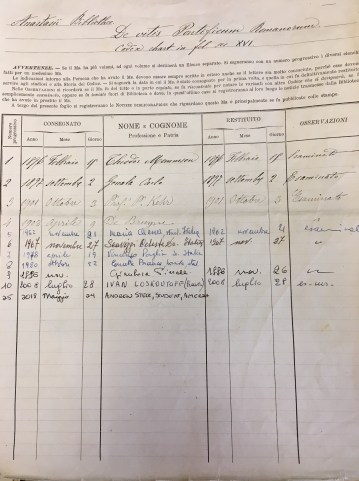
Leaving the Vatican Library resulted in a lovely three week period at the Biblioteca Vallicelliana, a small library adjacent to the church of Santa Maria in Vallicella. For anyone conducting research in Rome, I cannot recommend this library highly enough. The staff is so friendly, kind, and helpful that they made time fly and the manuscript collection is really quite excellent. I was able to consult eight manuscripts while there and take approximately 50,000 pages of notes and transcriptions. The staff let me look through the registers of the manuscripts and some of the preceding names on those lists are among the most important scholars in the last 150 years of medieval history. In an unexpected way, it was a tangible and jarring reminder of the breadth of the gigantic shoulders on which I am standing. Unfortunately I must leave the Vallicelliana and move to another library, which is a move that honestly saddens me a little bit. In addition to the people, I will miss my walk to the library along the Tiber in the morning and sitting in Santa Maria in Vallicella for a few minutes of quiet after lunch. I am excited, however, to find a new rhythm at the Biblioteca Casanatense in the next few weeks.
Theodor Mommsen and Paul Kehr are two foundational scholars for medieval history- it is amazing to see myself on any sort of list with them.
Every time I return to Rome I am reminded of the little things that I miss. The tomatoes and bell peppers here are like nothing that we get in America- they are so much richer and juicier. I literally eat a tomato every day because they are so delicious. I was also reminded of how much I love the Roman dish insalata di riso, which is a chilled rice salad with vegetables, hard-boiled eggs, and usually some sort of cold cuts. It works well as a light, but filling, lunch during the hot Roman summers. I have also been drinking as much acqua frizzante as I can get my hands on. This is a somewhat fizzy water whose carbonation is not as belligerent as American sparkling waters. Even the version of San Pellegrino that we have in America seems to have more punch than the same brand here. If any grocery stores (especially in Iowa City) happen to read this, please stock some acqua frizzante!
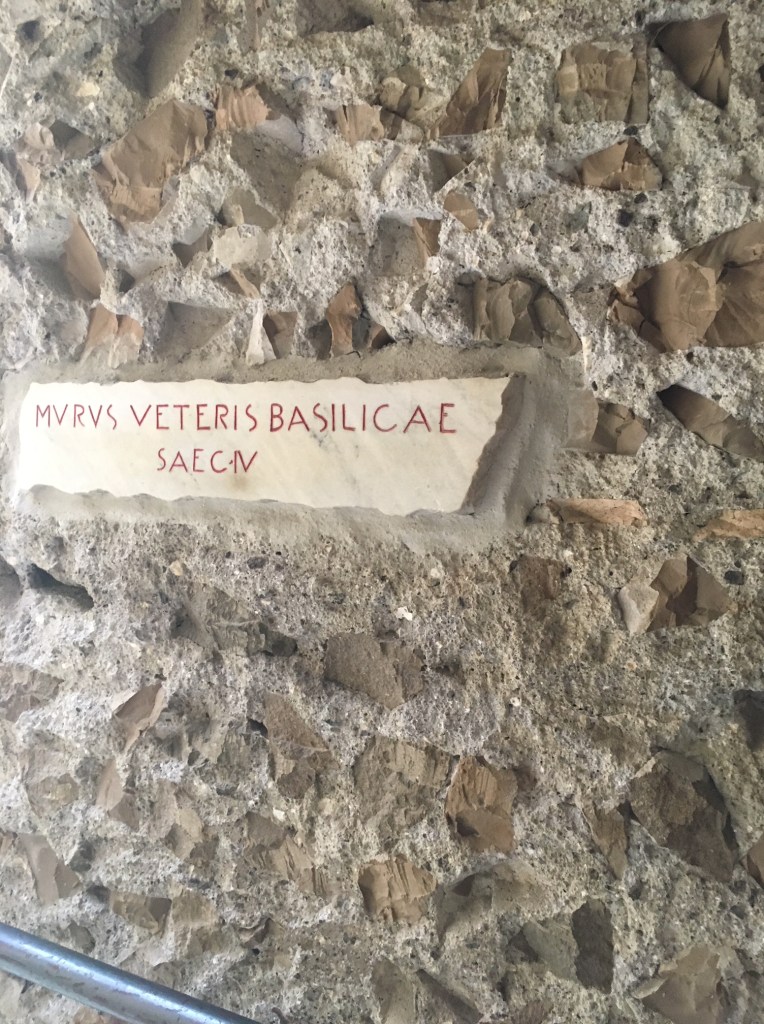
It has also been nice to reacquaint myself with the physical city. I always try to see new places when I am here, but returning to some familiar places is nice. I always make a point of returning to Sta. Maria in Aracoeli, the nave of which is lined with these beautiful glass-beaded chandeliers that refract light and transform the interior of the basilica. In San Paolo fuori le mura there is a section of the original fourth century foundations that I always go to see, just to put my hand on it and feel the ancientness of the church. I had a similar experience when I visited Sta. Prassede this summer for the first time ever. Much of the ninth-century renovations done by Pope Paschal I are still visible and touchable, unlike many other churches in Rome that were heavily renovated during the 17th and 18th centuries. The medievalness of the church is almost tangible and I think it is amazing. It sounds corny, I know, but it is little things like that that make me so happy to be a medievalist.
A part of the original foundations at San Paolo fuori le mura. The caption reads “A wall of the ancient basilica, 4th century”
 Rome-away-from-Rome